Dalton family earrings
Native SonThe Dalton family earrings are a custom-made heirloom whose passage through generations becomes central to identifying Mary Dalton after her body is burned in Dalton's furnace. One earring, blackened but still recognizable, survives in the ashes. Its recovery turns a small domestic object into physical evidence: it links the remains in the furnace to Mary and carries her family history into the inquest and trial.
The heirloom and its inheritance
The earrings belonged to a pair that Mrs. Dalton said she had owned for thirty-three years. She described a succession of inheritance: her grandmother gave the earrings to her mother when her mother came of age; her mother then gave them to Mrs. Dalton when she came of age; and Mrs. Dalton, in turn, gave them to her daughter at eighteen. The object’s history is therefore also a record of the family’s maternal line, transmitted through a specific gift rather than merely associated with the family in general.
Mrs. Dalton testified that Mary wore the earrings all the time. She was certain that the surviving earring belonged to the pair: her grandmother had designed and commissioned them, and there were no others like them. That combination of habitual use and claimed uniqueness makes the heirloom identifiable in a way an ordinary piece of jewelry would not be. Its evidentiary force depends not simply on its having belonged to the family, but on the family’s account of how it was made, passed down, and worn.
Recovery from the furnace
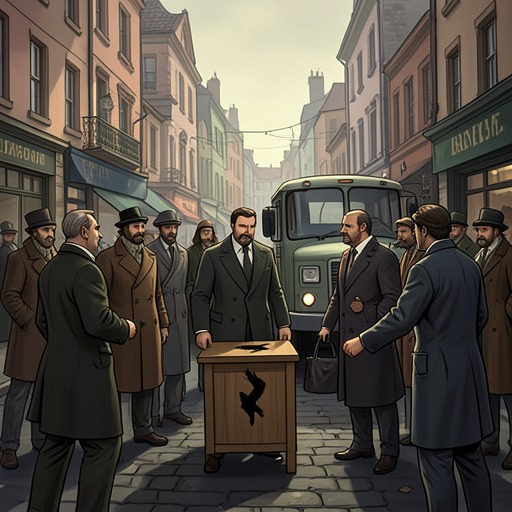
At the inquest, the coroner lifted a tiny piece of blackened metal from the table and brought it to Mrs. Dalton. He explained that police had retrieved it from ashes in the basement furnace of her home, then asked her to feel it and say whether she recognized it. The object’s condition and location mattered: it was not presented as an intact heirloom but as a remnant recovered from the place where Mary’s remains had been found.
Bigger watched as Mrs. Dalton held the metal. Her hand trembled; she fumbled with it, and then her shoulders shook as she began to cry. A woman in the room also sobbed, and murmurs rose before the coroner restored quiet. The proceedings thus make the recognition more than a verbal identification. The tiny fragment is handled in public, and the family’s loss becomes visible in Mrs. Dalton’s physical response as the object is recognized.
The coroner explained that the other earring had been destroyed in the fire, while this one had fallen through the furnace grates into the bin below. That explanation accounts for why a single piece survived the burning. The furnace had consumed the body and destroyed one member of the pair, but the other passed through the grates and remained available for identification. The surviving fragment is both evidence of destruction and a limit to it: the attempt to reduce the body to ashes did not erase every trace connecting it to Mary.
Testimony at the trial
The earring returns during the trial through testimony from Mrs. Rawlson, whom Bigger had not seen before. He hears Buckley identify her and hears her say that she is Mrs. Dalton’s mother. Buckley gives her the earring seen earlier at the inquest, and Mrs. Rawlson recounts how the pair had been handed down from mother to daughter over the years. The testimony confirms the heirloom’s history through another member of the family, rather than leaving its identity dependent on Mrs. Dalton’s recognition alone.
Mrs. Dalton then takes the stand and tells the same story she told at the inquest. Max declines to examine Mrs. Rawlson or the State’s other witnesses. In the trial scene, the earring is therefore not introduced as a newly discovered clue; it is a known object whose earlier identification and family history are carried forward into the courtroom. Its reappearance gives the testimony continuity across the investigation and trial, while Bigger’s perception of the proceedings keeps the object tied to the account of evidence being presented against him.
Evidentiary and narrative significance
The earrings’ role rests on a chain of particular claims: one was recovered from the furnace ashes; Mrs. Dalton recognized it as one of a unique pair; she testified that Mary wore the pair continually; and Mrs. Rawlson described its inheritance across generations. Together, these details make the surviving earring a material link between the remains and Mary. The object does not, by itself, tell the full circumstances of her death or establish every part of the case. Its significance is narrower and concrete: it helps identify whose remains were burned in the furnace.
The heirloom also changes meaning according to where it appears. Before the inquest, it belongs to a family history of gifts and inheritance. At the inquest, it is blackened metal in the coroner’s hand, recovered from the furnace and recognized through touch. At trial, it becomes an exhibit around which testimony from mother and daughter converges. Its passage from private possession to public evidence makes the concealed destruction legible: what was meant to disappear leaves behind a small, specific trace that the family can name.